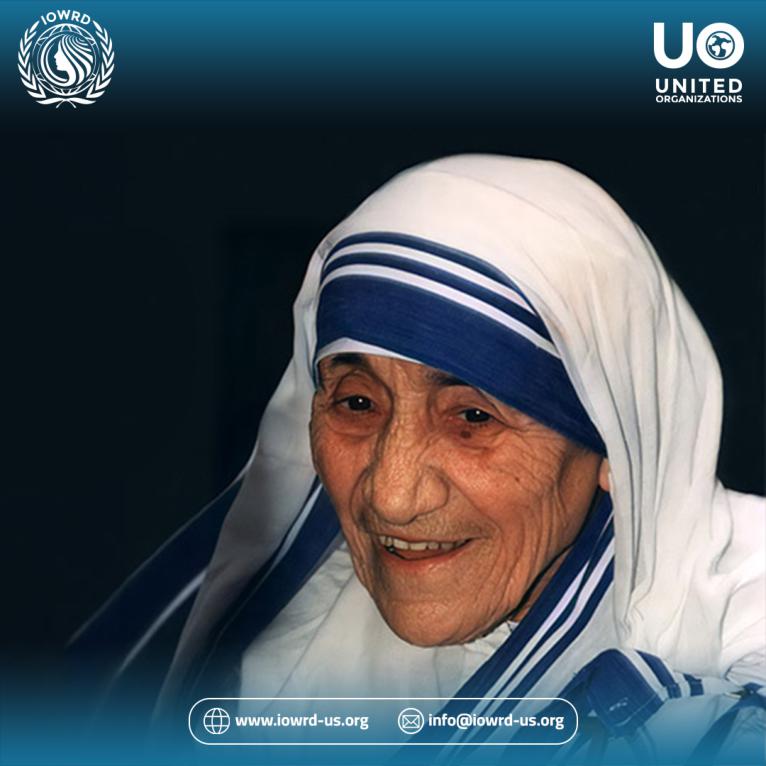

In the corners of history, where names intertwine with titles, and victories with clamor, there remain stories written not with ink, but with the pulse of hearts. Among these stories stands the tale of a woman who etched her name in the annals of human history, creating a different kind of resonance… the resonance of compassion. Mother Teresa was neither a conqueror of borders nor a military leader, but a traveler toward the wounded, carrying in her hands what cannot be bought or sold: a healing touch, a comforting gaze, and a silence that translates the language of pain into action. She was born into a humble home and environment, where the call of life intertwined with the call of duty. But fate had a different path in store for her, leading her to a city plagued by poverty. There, she decided to be a refuge for the vulnerable, proving that true leadership can spring from the depths of poverty and suffering.
From Agnes to Mother Teresa: Her Upbringing and Spiritual Formation
Agnes Gonxha Bojaxhiu (later Mother Teresa) was born on August 26, 1910, in Skopje (the capital of modern-day Macedonia), to a middle-class Albanian Catholic family. From a young age, she was influenced by the teachings of the Church and her mother’s charitable work for the needy in her neighborhood. This was the first lesson that instilled in her the seeds of compassion and early generosity. At the age of eighteen, she left home to join the Loreto Sisters in Ireland, where she learned English and began her spiritual journey. In 1929, she moved to Calcutta, India, to work as a teacher at St. Mary’s School. These years were not merely a period of professional training, but a period of spiritual and intellectual refinement and inner growth, preparing her for a radical transformation that would change the course of her life and the lives of millions she would later encounter.
The Call That Changed the Course of History: The Journey and the Radical Transformation
After two decades of teaching and religious life, in 1946, Mother Teresa experienced what she called “the vocation within the vocation,” feeling a clear spiritual calling to serve the poorest of the poor in the slums of Calcutta. After years of preparation and obtaining ecclesiastical approval, she founded the Missionaries of Charity in 1950. It began with a small class teaching homeless children and quickly transformed into a global humanitarian network comprising thousands of nuns and volunteers from diverse religious and cultural backgrounds. The movement was not purely religious; rather, it became a model of humanitarian work that transcends borders, operating in areas of conflict, epidemics, and natural disasters, without discrimination or conditions.
A Legacy Beyond Awards: From Nobel Peace Prize to Canonization
For more than five decades, Mother Teresa dedicated her life to caring for the sick, the homeless, widows, and orphans. She established nursing homes, leper colonies, and specialized units for AIDS patients at a time when they faced social stigma. She also provided emergency relief during famines and disasters in India and beyond. In 1979, she was awarded the Nobel Peace Prize in recognition of her efforts, and in 2016, the Catholic Church canonized her as Saint Teresa of Calcutta. But what truly immortalizes her is not the honors bestowed upon her, but the example she set: female leadership based on practical compassion, patience, and courage in the face of poverty and disease, without waiting for vast resources or official guidance.
How does Mother Teresa inspire women’s empowerment movements today?
Mother Teresa’s influence extends beyond the charitable and religious spheres; she has become a living example that is reshaping the concept of female leadership in the modern age. Women’s rights organizations, foremost among them the International Organization for the Defense of Women’s Rights, understand that true women’s empowerment is not built in a vacuum, nor does it always begin in official halls. Rather, it begins with revisiting the stories of women who paved the way for change through means that may seem simple at first glance, but which have proven over the decades to be the most profoundly impactful. Through conferences, research, and awareness programs, these organizations highlight figures like Mother Teresa as shining examples that women are capable of leading global humanitarian movements without needing political influence or huge budgets. By consciously linking the memory of the past with the vision of the future, her legacy is transformed from a religious or charitable memory into a message of empowerment. A message reminding us that recognizing women’s achievements is not a mere formality, but a cornerstone in building more just societies, where humanitarian giving intertwines with the struggle for rights, and where women prove, time and again, their ability to shape history with their hands, minds, and hearts.
A light that time cannot extinguish: Mother Teresa’s legacy in the memory of humanity.
Mother Teresa remains a living testament that a woman’s true success is not measured by position or wealth, but by the human capacity to transform pain into hope, and poverty into dignity. From her humble beginnings to her global journey, and from her humanitarian work that touched the hearts of millions, she presented a unique model of female leadership based on service and faith in humanity. While organizations like the International Women’s Rights Organization continue their struggle to highlight women’s historical and contemporary role, Mother Teresa’s legacy remains a beacon reminding us that true leadership begins with compassion, and that woman is not merely a part of humanity’s journey, but its beating heart, its conscious mind, and the creative force that builds civilizations and reshapes the world’s destiny with a touch of dignity and hope. Every hand extended to help someone in need is an extension of her vision. Giving, as she taught us, is not a fleeting act, but a way of life that reshapes history with a purely human touch.
Sources:
– Mother Teresa
https://ar.wikipedia.org/wiki/الأم_تريزا
– Missionaries of Charity (Mother Society). Historical Archives and Institutional Foundation.
– Women Who Made History: From Relief to Community Leadership. Geneva: International Alliance of Women.
https://www.iaw-women.org
– Nobel Prize Foundation. Mother Teresa: Facts and Biography.
https://www.nobelprize.org/prizes/peace/1979/teresa/facts
Keywords:
Mother Teresa, Missionaries of Charity, Nobel Peace Prize, Women’s Empowerment, Saint Teresa of Calcutta.